





Email:
global@GCP-ClinPlus.com


From a Collaborating PI to a Trial-Ready Site: What Should Sponsors Evaluate When Planning an AD Study in China?
A large patient population and a renowned principal investigator do not automatically translate into predictable study delivery.
For Alzheimer’s disease (AD) clinical research, sponsors need to answer several practical questions:
• Can the site identify and reach the target patient population?
• Can it support biomarker confirmation and appropriate patient stratification?
• Can it consistently deliver treatment, safety monitoring, and long-term follow-up?
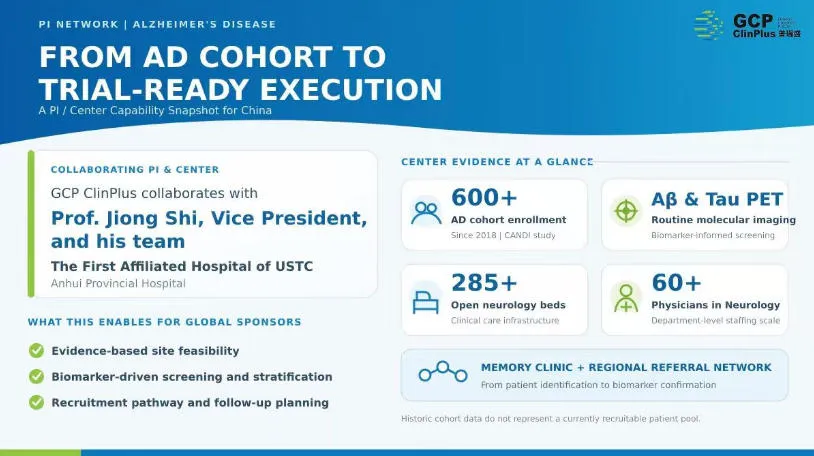
GCP ClinPlus collaborates with Professor Jiong Shi, Vice President of the First Affiliated Hospital of USTC (Anhui Provincial Hospital), and his team. This collaboration connects specialized PI expertise with site assessment and clinical execution capabilities for neurodegenerative disease research.
Professor Shi’s team has long focused on brain aging, cognitive impairment, and neurodegenerative diseases. Since 2018, the institution has maintained a clinical cohort for cognitive disorders that has historically included more than 600 patients with AD.
Research based on the China Aging and Neurodegenerative Initiative (CANDI) cohort has been published in Alzheimer’s & Dementia, exploring AD biomarkers and precision diagnostic models for the Chinese population.
The institution’s capabilities also include:
• A dedicated memory clinic and regional referral network
• Cerebrospinal fluid and blood-based biomarker testing
• Routine Aβ and Tau PET imaging
• More than 285 beds and 60 physicians within the Department of Neurology
• Experience leading or participating in multiple AD-related clinical studies
Importantly, a historical cohort should not be interpreted as a currently recruitable patient pool.
Its greater value lies in providing evidence for site feasibility: helping study teams assess patient pathways, build realistic screening funnels, define biomarker-confirmation processes, and identify potential treatment and follow-up risks before study initiation.
For global pharmaceutical and biotech companies planning AD or other neurodegenerative disease studies in China, site selection should go beyond a list of well-known investigators. It should be grounded in verifiable patient pathways, technical capabilities, and operational readiness.
Building on collaborations with clinical experts such as Professor Shi and 23 years of clinical research experience, GCP ClinPlus supports PI and site matching, recruitment-pathway assessment, site feasibility analysis, and study execution in China.
Our goal is to help sponsors move beyond “finding an expert” toward building a clinical research network that can deliver.
Planning an AD or neurodegenerative disease study in China? Let’s discuss PI and site identification and an initial feasibility assessment.
#AlzheimersDisease #NeurodegenerativeDiseases #ClinicalTrials #ChinaClinicalTrials #Biomarkers #SiteFeasibility #GCPClinPlus