




Email:
global@GCP-ClinPlus.com


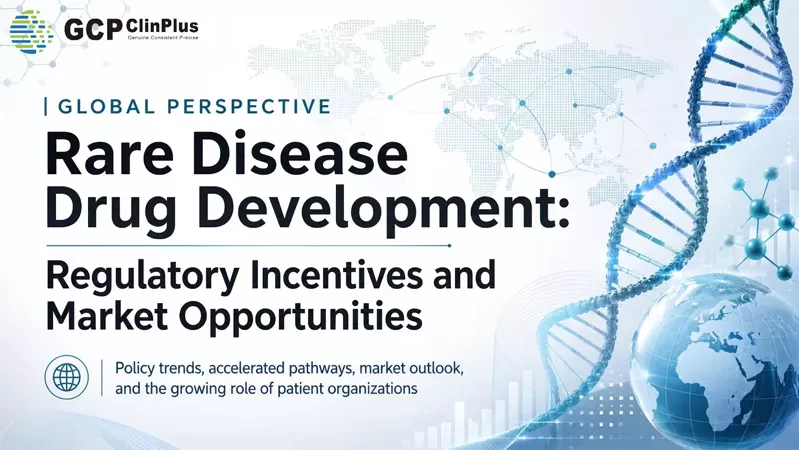
Rare diseases were once viewed as “small-population, small-market” conditions. Today, this perception is being reshaped by evolving global regulatory policies and market dynamics.
From FDA orphan drug designation, to EMA’s orphan designation and market exclusivity framework, and to China’s combined support system built around rare disease catalogs, priority review, conditional approval, urgently needed overseas-approved medicines, and patient-focused drug development, rare disease drug development is moving from a high-cost, high-uncertainty niche into a strategic gateway for precision medicine, gene therapy, RNA therapeutics, cell and gene therapies, and high-value specialty markets.
Globally, thousands to tens of thousands of rare diseases have been identified, yet only a limited proportion have approved treatment options. Research suggests that approximately 5% of rare diseases have an FDA-approved drug, highlighting the substantial unmet medical need that remains. [1]
The United States has one of the most mature orphan drug frameworks globally. FDA orphan drug designation may provide sponsors with tax credits for qualified clinical research, user-fee waivers, and a potential seven-year period of market exclusivity after approval. [2] This system has significantly influenced the structure of new drug development. Among the 50 novel drugs approved by FDA CDER in 2024, 26, or 52%, were for rare or orphan diseases. [3]
The European Union places greater emphasis on a closed-loop framework from early designation to post-approval exclusivity. EMA includes diseases affecting no more than 5 in 10,000 people within the orphan medicines framework, and encourages development through mechanisms such as protocol assistance, fee reductions, and 10 years of post-approval market exclusivity. [4][5] According to EMA public information, since 2000, the EU has granted more than 3,170 orphan designations and approved more than 275 orphan medicines. [4]
Notably, the EU is advancing pharmaceutical legislation reform, aiming to rebalance innovation incentives, patient access, and market competition. The emerging policy direction suggests that orphan drug incentives will remain in place, but may increasingly be linked to high unmet medical need, real-world accessibility, and post-approval evidence responsibilities. [6]
China has developed a more locally tailored pathway. Although China has not yet established an orphan drug designation system fully equivalent to those of the FDA or EMA, it has built a combined support framework through rare disease catalogs, priority review and approval, conditional approval, pathways for clinically urgently needed overseas-approved medicines, and patient-focused drug development.
Following the release of the second rare disease catalog, China’s rare disease catalogs now cover 207 diseases. [7] NMPA public information shows that 55 rare disease medicines were approved for marketing in China in 2024. [8] Meanwhile, the Provisions for Drug Registration state that, for rare disease medicines included in the priority review and approval procedure, clinically urgently needed, and already approved overseas, the review timeline for the drug marketing authorization application is 70 days. [9]
This means that rare disease drug opportunities in China are no longer limited to filling therapeutic gaps. They are increasingly moving toward earlier identification, faster review, improved access, and stronger patient participation.
The central challenge in rare disease drug development lies in the small number of patients, high disease heterogeneity, and limited natural history data, combined with urgent unmet clinical need. As a result, regulators worldwide are increasingly adopting staged evidence-management models that balance early access with post-approval evidence generation.
Qalsody (tofersen) is a representative example. The drug is used for ALS associated with SOD1 mutations and was approved in the United States through the accelerated approval pathway. FDA’s approval was supported in part by reductions in plasma neurofilament light chain (NfL), a biomarker associated with axonal injury and neurodegenerative disease. [10] In the EU, Qalsody received marketing authorization under exceptional circumstances in 2024, reflecting a tiered approach to evidence uncertainty in rare and serious diseases. [11]
Elevidys illustrates another side of regulatory oversight for advanced therapies in rare diseases. As a gene therapy for Duchenne muscular dystrophy, Elevidys received expanded FDA approval in 2024, with part of the indicated population supported by traditional approval and part by the accelerated approval pathway. [12] However, FDA later updated the boxed warning due to risks of serious liver injury and acute liver failure, and restricted its indicated use. [13]
These cases send a clear signal: accelerated approval, conditional approval, and authorization under exceptional circumstances are not shortcuts or “discounted evidence.” Rather, they represent a dynamic regulatory contract. Sponsors may gain earlier market entry, but they must also take responsibility for post-approval evidence generation, safety monitoring, and risk management.
For rare disease medicines, true regulatory capability is not only about how to obtain approval faster. It is about how to build a credible balance among early evidence, patient benefit, long-term safety, and accessibility.
The market value of rare disease medicines is being redefined.
Different market research organizations use different definitions for rare disease treatments and orphan drugs, but the growth direction is highly consistent. Grand View Research estimates that the global rare disease treatment market will grow from approximately USD 216.2 billion in 2024 to approximately USD 374.4 billion by 2030, with a compound annual growth rate of about 11.6% from 2025 to 2030. [14] Data Bridge forecasts that the global orphan drugs market will grow from approximately USD 208.8 billion in 2024 to approximately USD 431.5 billion by 2032, with a CAGR of about 9.5%. [15] Evaluate also projects that orphan drugs will account for more than 21% of global prescription drug sales by 2032. [16]
Several core drivers are behind this trend.
First, genetic testing and newborn screening are improving patient identification, bringing previously “invisible” patients into the diagnostic and treatment pathway.
Second, RNA therapeutics, antisense oligonucleotides (ASOs), AAV-based therapies, cell and gene therapies, and targeted therapy platforms are maturing, making more genetic, neuromuscular, hematologic, metabolic, and rare tumor diseases potentially addressable.
Third, major markets including the U.S., EU, and China continue to provide regulatory incentives, reducing uncertainty in small-population drug development.
Fourth, patient organizations and real-world data are improving natural history studies, diagnostic pathways, and patient recruitment infrastructure.
Fifth, although payment systems face pressure from high prices, they are also exploring diversified access models, including reimbursement negotiations, installment payments, outcomes-based payment, commercial insurance, and charitable assistance.
However, market opportunity does not mean a low barrier to entry. The real commercialization challenge for rare disease medicines often goes beyond whether a product can be approved. It lies in whether patients can be diagnosed, whether treatment can be paid for, whether the therapy can be used over time, and whether its value can be continuously supported by real-world evidence.
Future competition will shift from single-product advancement to integrated capabilities in global evidence strategy, cross-regional registration pathways, patient identification networks, market access, and long-term safety management.
In rare diseases, the role of patient organizations is being redefined.
They are no longer only disease advocates. They are increasingly involved in natural history studies, patient registries, real-world data generation, patient-reported outcome development, disease education, policy communication, and access pathway development.
The Cystic Fibrosis Foundation is a classic example. Through a venture philanthropy model, the foundation supported the development of cystic fibrosis therapies and, in 2014, sold royalty rights related to Vertex therapies for USD 3.3 billion, reinvesting the proceeds into research, care, and patient programs. [17] This case demonstrates that, in rare diseases, patient organizations can become important sources of capital and data infrastructure within the innovation ecosystem.
Regulators are also strengthening patient participation at the institutional level. FDA’s Patient-Focused Drug Development guidance emphasizes the systematic collection of input from patients and caregivers to support medical product development and regulatory decision-making. [18] EMA’s Patients’ and Consumers’ Working Party provides a formal platform for communication between EMA and patient and consumer organizations. [19] In China, the CDE’s CARE Plan also explicitly encourages sponsors to listen to patient voices and pay attention to patient experiences and perceptions throughout rare disease drug development. [20]
Rare disease drug development is therefore shifting from “developing for patients” to “developing with patients.”
Conclusion: The Real Opportunity in Rare Diseases Lies in the Systematic Integration of Policy, Evidence, Patients, and Access
Rare disease drug development is evolving from a niche public-interest topic into one of the most strategically valuable areas of global pharmaceutical innovation.
However, the core capability required in this field is not simply obtaining orphan drug designation, nor merely entering an accelerated or conditional approval pathway. What ultimately determines long-term value is whether a company can integrate regulatory strategy, patient engagement, evidence generation, post-approval commitments, and payment accessibility.
The future winners may not be the companies that initiate projects earliest, but those that build global perspectives, patient trust, and closed-loop evidence generation earliest.
How do you view the balance between regulatory incentives and evidence requirements in rare disease drug development? Will the next major breakthrough come from gene therapy, RNA therapeutics, or more precise patient identification systems?
[1] Fermaglich LJ, Miller KL. A comprehensive study of the rare diseases and conditions targeted by orphan drug designations and approvals over the forty years of the Orphan Drug Act. Orphanet Journal of Rare Diseases. 2023.
[2] FDA. Designating an Orphan Product: Drugs and Biological Products.
[3] FDA CDER. Advancing Health Through Innovation: New Drug Therapy Approvals 2024.
[4] EMA. Orphan designation: Overview.
[5] EMA. Market exclusivity: orphan medicines.
[6] European Commission. Reform of EU pharmaceutical legislation.
[7] National Health Commission / NMPA. China releases second catalog of rare diseases.
[8] NMPA. Measures facilitate approval of 48 first-in-class innovative drugs. 2025.
[9] NMPA. Provisions for Drug Registration, Article 96.
[10] FDA. FDA approves treatment of ALS associated with a mutation in the SOD1 gene.
[11] EMA. Qalsody EPAR.
[12] FDA. FDA expands approval of gene therapy for patients with Duchenne muscular dystrophy.
[13] FDA. FDA approves new safety warning and revised indication limits use of Elevidys following reports of fatal liver injury.
[14] Grand View Research. Rare Diseases Treatment Market Size & Trends Report.
[15] Data Bridge Market Research. Orphan Drugs Market Report.
[16] Evaluate. Orphan Drugs Content Hub / Orphan Drug Report.
[17] Cystic Fibrosis Foundation. Our Venture Philanthropy Model.
[18] FDA. Patient-Focused Drug Development Guidance Series.
[19] EMA. Patients’ and Consumers’ Working Party.
[20] NMPA CDE. Patient-Centered Action for Rare Diseases Encouragement, “CARE Plan”.
#RareDiseases #OrphanDrugs #DrugDevelopment #RegulatoryScience #MarketAccess #PatientEngagement #Biotech #FDA #EMA #NMPA #CDE #PrecisionMedicine #CRO