





Email:
global@GCP-ClinPlus.com

Dr Long Jiang is the CEO of GCP ClinPlus, a Chinese CRO with operations in New Jersey. A former cardiovascular surgeon at Peking University People's Hospital, he shifted into clinical research after a fellowship at Duke Clinical Research Institute, and later also served as a partner in a private equity firm focusing on the pharmaceutical industry. In 2023, he joined GCP ClinPlus which is a specialised CRO with 400 staff, more than 2300 clinical projects, and has played a landmark role in China's first approved stem cell therapy for acute graft-versus-host disease (aGVHD). In this conversation, he discusses the evolution of Chinese clinical research, US-China tensions, and why he believes the traditional CRO model may be reshaped by the end of the decade.
You spent more than a decade as one of China's leading cardiovascular surgeons before founding a clinical research organisation. What motivated that transition, and how did your medical background shape the business you built?
It is a long story. I was working as a cardiothoracic surgeon for more than ten years at Peking University People's Hospital – one of China's top-tier hospitals. I was among the leading coronary artery bypass surgeons in the country at that time, travelling to over 100 hospitals across China and performing over 500 operations each year. But I was given the opportunity to go to Duke University, to the Duke Clinical Research Institute (DCRI), as part of a collaboration between Peking University and Duke on clinical trials and academic research organisation models. That experience changed everything for me. At the time, approximately 20years ago, clinical trials were an emerging new concept in China – most physicians had limited understanding of their design and execution. I saw that as a significant opportunity, and I decided to adapt the DCRI model for China: a physician-oriented, patient-centred CRO built from within the medical community.
The advantage of this starting point was clear: I already knew the clinicians.In the early days, I had no pharmaceutical clients—only deep relationships with leading physicians in cardiology, diabetes, and other specialties. By engaging with them on clinical research design and operations, I gradually bridged into the biopharma industry. This physician-first, science-driven foundation remains a core differentiator for GCP ClinPlus today.
More than 23 years on, where does GCP ClinPlus stand today? How has the business evolved?
GCP ClinPlus has a 23+ year history of adaptive growth, reflecting both China's biopharma expansion and shifting global collaboration dynamics. We are proud of our resilience and consistent delivery amid market fluctuations. The SMO business itself was eventually listed on the Chinese stock market under the name SMO GCP ClinPlus, approximately four years ago. GCP ClinPlus is now specifically our CRO operations. We consider ourselves a mid-sized CRO in China – around 400 employees across China and a small presence in New Jersey.
Our focus has always been on technically advanced areas. Over the past five years I have also served as a partner in a private equity,this investment background has given me a unique perspective and deep insight into the core value and potential driving the future of the industry in technically complex, high-growth advanced therapy areas—such as cell and gene therapy (CGT) and oligonucleotides,, and our CRO capabilities have been built to serve that space. We offer full-service capabilities – from medical affairs through data management, biostatistics,statistical programming, and regulatory submissions including NDA support.
In terms of clients, the early years were dominated by multinationals. Over the past ten years, the Chinese biotech sector has expanded very rapidly and our client base has shifted accordingly. Today, the majority of our clients are Chinese biotechs, and increasingly, they are pursuing global rather than domestic-only registrations.
You describe GCP ClinPlus as a China-to-global gateway for your clients. How do you balance the speed advantage that China offers with the rigorous standards required by the FDA and the European Medicines Agency?
Based on our experience, China genuinely shortens overall study timelines by around 30 percent compared with traditional global development models. This comes from several factors. Communication between the sponsor, the CRO, the hospital, and the investigator is more direct and highly coordinated than in many other markets. Leading hospitals in China now have experienced and well-organised clinical trial teams – Chinese physicians have come to understand that clinical trials are not only commercially worthwhile but provide access to high-level international publications. Chinese investigators are also highly motivated, particularly for programmes addressing serious unmet medical needs. The result is that site activation, investigator alignment, patient screening, and operational coordination are all substantially faster than they were even 10 years ago. Government policy has reinforced this, with active encouragement from health authorities for hospitals to accelerate their clinical trial activity.
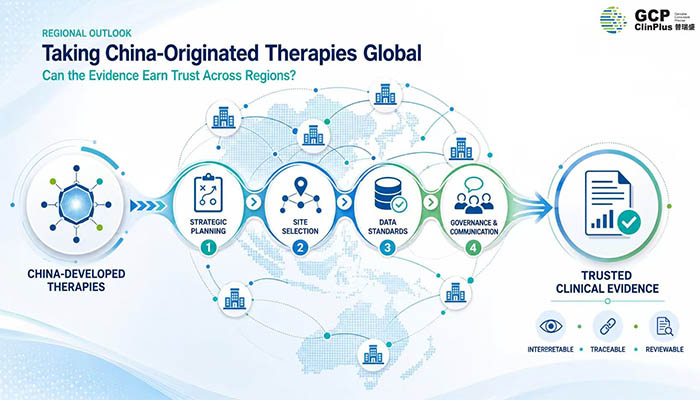
But the more important question – and I think the more honest one – is not simply whether China is fast. It is whether China can generate data that global regulators fully trust. That is a fundamental shift in what the industry requires, and it represents a real change in mindset for many organisations. In the past, some CROs and sponsors focused primarily on speed. Today, global development programmes require a much stronger emphasis on data integrity, traceability, regulatory compliance, patient safety, and risk-based quality management. At GCP ClinPlus, we have built our quality systems not around passing inspections but around generating globally credible clinical evidence from the beginning of every project.
To support this, we have developed a proprietary AI-enabled operational platform we call GCP ClinPlus Clinx. This system incorporates all relevant guidelines and protocols from the FDA, the EMA, and the Chinese NMPA, linked to the accumulated operational experience from over 2300 of our past projects. For any new programme, the system automatically aligns data collection, patient safety monitoring, and all operational procedures with the applicable regulatory requirements. The question – can China generate data that global regulators fully trust – is the central challenge our organisation has built itself around answering.
GCP ClinPlus has an important milestone in cell and gene therapy – the first approved stem cell therapy for acute graft-versus-host disease in China. Can you tell us that story?
It is one of the most meaningful milestones of my career and a profound learning experience for our team.
My original motivation for moving from surgery to clinical research was a simple realisation: as a surgeon, I could treat perhaps 5,000 patients in my entire career, working as hard as I could. Gene therapy and cell therapy, by contrast, have the potential to cure certain diseases completely and permanently. That possibility drew me in.
The aGVHD stem cell therapy programme was the first time I truly understood how different advanced therapy development is from conventional drug development. It is not simply a more complex version of the same process – it requires an entirely different way of thinking. At the time, the regulatory pathway in China for cell therapies was still evolving. Many hospitals and investigators had limited experience with this class of product. Even convincing regulators, physicians, and patients that a stem cell therapy was scientifically valid and worth pursuing was itself a significant challenge. There was a great deal of scepticism to overcome.
The first lesson I took from that experience was this: cell therapy cannot be managed in the same way as traditional drug development. You have to address not only the clinical procedure but the entire supply chain – including the manufacturing side. Maintaining consistent product quality for each individual patient, which is a fundamental requirement of personalised cell therapies, is a genuinely difficult problem in a way that has no equivalent in small-molecule development.
The second lesson was about focus. At the time, there was considerable excitement in China about stem cells – claims that they could cure almost any disease. I took a different view. I believed we needed to identify a small, specific indication where the science was strong and where we had a realistic chance of generating convincing data. We chose paediatric aGVHD because the existing data suggested a high probability of meaningful clinical response, and because the patient need was acute and urgent. Given the critical condition of these patients and the time-sensitive nature of treatment decisions, the programme depended on an integrated system – not just a protocol. Every element had to work together: manufacturing, logistics, hospital coordination, investigator judgement, and patient management. We were fortunate. The programme succeeded. And it taught me that in this field, success depends on the integrity of the whole system, not on any single element within it.
China has been synonymous with oncology in terms of clinical trial activity. But you seem to be seeing a shift. Which therapeutic areas are showing the most aggressive growth in your portfolio?
One of the most exciting changes happening in China right now is that innovation is no longer concentrated almost exclusively in oncology. For many years, PD-1 inhibitors and antibody-drug conjugates dominated the focus of the Chinese biotech industry, and China produced a very large number of these products. But we are now seeing very rapid growth in several other therapeutic areas.
Ophthalmology is one I find particularly compelling, and I have made personal investments in this space. Age-related macular degeneration and other retinal diseases are well suited to gene therapy approaches, and China has several important structural advantages here. The patient population is enormous. China has built some very strong ophthalmology centres – major eye hospitals in Beijing and other cities with extensive investigator networks and significant experience in organising complex clinical trials. There has also been meaningful advancement in standardising clinical endpoints for ocular conditions in China, with Chinese physicians now having genuine expertise in the imaging measurements and outcome assessments that global regulators require. The result is that Chinese biotech companies are becoming increasingly active not just in biosimilars for eye disease but in innovative biologics, targeted therapies, and gene therapies.
Metabolic disease may be an even larger opportunity. The rise of GLP-1 therapies has transformed the global pharmaceutical landscape, and China has the world's largest population of patients with obesity and diabetes. Chinese companies are moving very aggressively into this field. I have a close collaboration with Professor Ji Linong at Peking University People's Hospital – the leading principal investigator in diabetes and metabolic research in China – and the conversations we have had reflect just how internationally significant the Chinese investigator network in this field has become. The majority of major international clinical trials in obesity are now being led or co-led by Chinese physicians. That is a structural change, not a temporary one.
I also want to mention rare diseases, which is another area changing very quickly. China's patient population gives it a statistical advantage in recruiting for rare disease trials that is genuinely significant.
Taken together, I believe the combination of patient scale, investigator expertise, and increasingly AI-enabled clinical infrastructure represents China’s strongest long-term competitive advantage in global clinical development.
The geopolitical environment – US-China tensions, the BIOSECURE Act – creates real complexity for a company operating in both markets. How are you navigating that, and do you see any opportunity within it?
It is a significant challenge, and I want to be honest about that. Over the past few years we have had many conversations internally and with clients about data security, supply chain integrity, regulatory alignment, and the evolving policy environment – not just in pre-clinical research but in clinical development as well. These developments are creating real complexity for companies that operate across both the Chinese and US ecosystems. Drug development remains fundamentally global, and that tension between the political environment and the scientific imperative creates genuine inefficiency.
At the same time, there is an opportunity that I think is real. The BIOSECURE Act and broader restrictions on the largest Chinese CROs have created a situation where some global pharmaceutical companies are actively looking for alternative partners in China who do not carry the same regulatory or political risk profile. Last year we had more than 30 inbound client enquiries from companies wanting to conduct clinical trials in China – that level of interest from international sponsors is a significant change from even three years ago.
Our response has been to formalise what we call a complementary operating model. We maintain operations in both China and the United States – Hangzhou and Beijing on the China side, New Jersey in our New Jersey office. They have become genuinely complementary functions. The China side focuses on clinical execution, patient access, investigator networks, and operational efficiency. The US side focuses on global business development, regulatory strategy, partnership development with biotechs and investors, and international regulatory submissions. The two sides do not compete; they serve different purposes, and together they provide a buffer against political risk and cross-border regulatory complexity. This structure also helps build trust with global pharmaceutical companies and investors who need to be confident that their data and their programmes are being managed to international standards with appropriate governance on both sides.
In a market as competitive as China's CRO sector, how do you avoid the race to the bottom on pricing that affects so many service businesses here?
Being a mid-sized CRO is actually a significant advantage in this respect. We do not have the cost base or the organisational complexity of the large global CROs, and we do not need the volume of work they require to sustain their scale. Our strategy has been to find clients with whom we become genuine working partners rather than service vendors.
Many biotech companies – particularly the smaller and mid-sized ones that make up a large part of our client base – are no longer looking for a pure outsourcing vendor. They want a strategic and operational partner who genuinely understands their programme and helps them manage it intelligently. For that kind of client, scientific understanding, speed of decision-making, and the quality of management attention matter more than organisational scale. Our physician background and long-standing relationships with investigators mean we approach every project from a clinical and scientific perspective, not only an operational one. We can have a genuine conversation about clinical need, patient selection, and protocol design in a way that is difficult for an organisation built primarily around process execution.
We are also more agile. In a large publicly listed CRO, decision-making is slow and reaching a senior person is difficult. At GCP ClinPlus, clients can reach me directly. For a biotech founder running a company under financing pressure – needing clean data quickly to support the next funding round – the ability to get a decision made immediately rather than waiting two weeks is not a minor convenience. It is genuinely important.
The third differentiator is our ConnectClinx platform. We have embedded more than 23 years of GCP ClinPlus operational experience and knowledge from over 2300 clinical projects into an AI-enabled clinical research infrastructure system. We make this available to our clients not simply as a software tool but as a way of helping them understand and manage their own programmes. The founder of one client company told me recently that for the first time they felt they did not need to spend months learning FDA and NMPA guidelines from scratch – the system automatically incorporates that regulatory experience into their workflows. It gives sponsors real-time visibility and strategic control over their programme in a way that traditional outsourcing does not. That transparency, and that sense of shared ownership over the outcome, is what distinguish a genuine partnership from a vendor relationship.
If we speak again in five years, what will you have built, and what do you believe the CRO industry will look like by 2030?
Honestly, I believe the traditional, execution-focused CRO model may not be sustainable by the end of the decade. That is not an observation made from a position of pessimism – it is the reason I have been investing so heavily in our AI platform.
For the past 23 years, CROs competed primarily on scale and execution efficiency. AI will gradually eliminate execution efficiency as a differentiator. Pharmaceutical companies will be able to use AI systems to manage many of the processes that currently require large CRO workforces. What that means is that the organisations that survive and thrive will not be those with the largest headcount – they will be those that combine AI-driven operational intelligence with genuine clinical insight and deep global regulatory experience.
This is the direction in which GCP ClinPlus is evolving. I see our future not as a traditional CRO but as a new kind of clinical development consulting and infrastructure company – one where our platform, our accumulated knowledge, and our clinical expertise work together to help sponsors increase the probability of their trials succeeding, not simply to execute the procedures within them. The question we want our clients to ask is not “did GCP ClinPlus complete the protocol?” but “did GCP ClinPlus help us succeed?” That shift from execution to outcome is fundamental.
I have already begun preparing my data management and biostatistics team for this transition. I tell them directly: your role in the near future will not be programming or data cleaning – the AI will do that. Your role will be to look at the data and identify the risks in a clinical trial, find ways to shorten timelines, reduce patient burden, discover biomarkers that make success more likely. That is the intelligence layer that no software can yet replace, and that is where the real value will lie.