





Email:
global@GCP-ClinPlus.com


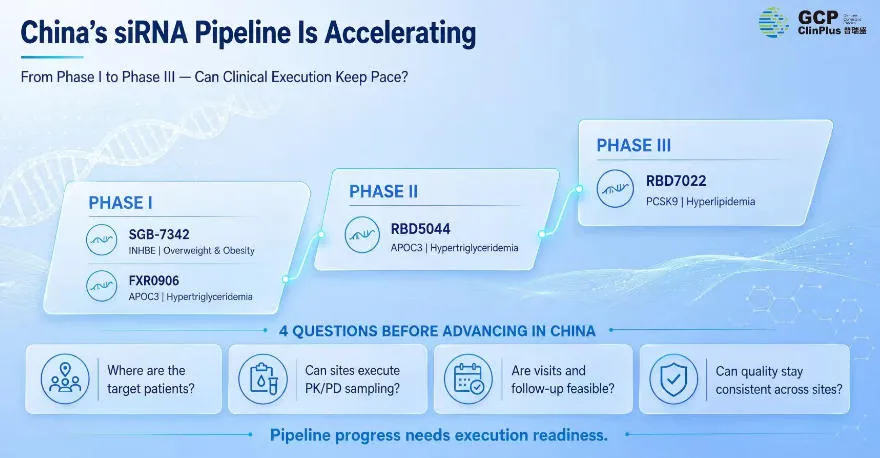
As an siRNA program advances into Phase II or Phase III, the key challenge often extends beyond the molecule itself. Sponsors must identify clinical sites with access to the right patients, protocol-specific sampling capabilities, and the operational capacity to support long-term study execution.
Publicly available information as of July 2026 shows that China’s siRNA pipeline is progressing across multiple clinical stages:
• RBD7022: A PCSK9-targeting siRNA for hyperlipidemia that has advanced to Phase III development in China
• RBD5044: An APOC3-targeting siRNA for hypertriglyceridemia, with Phase II development underway in China and Europe
• SGB-7342: An INHBE-targeting siRNA for overweight and obesity that has entered Phase I development in China
• FXR0906: A liver-targeted, APOC3-directed siRNA that has received regulatory clearance to initiate Phase I development in China
For global sponsors, the real value of this pipeline snapshot lies not in remembering the individual program names, but in recognizing three important shifts:
1. Programs are advancing into later-stage development
As assets progress from early safety studies toward confirmatory development, site-selection criteria, patient-volume requirements, and expectations for consistency across sites become increasingly demanding.
2. Less frequent dosing does not mean simpler trial operations
Even when dosing frequency is reduced, critical visit windows, PK/PD sampling, sample handling, long-term follow-up, and patient retention still require careful planning and consistent execution.
3. More sites do not necessarily mean a more capable site network
A long list of hospitals does not automatically translate into an executable clinical network. Patient distribution, competing trials, investigator experience, laboratory capabilities, and operational readiness must all be assessed in advance.
At GCP ClinPlus, we believe sponsors should answer four key questions before advancing an oligonucleotide program in China:
• Where are the target patients concentrated geographically and across relevant medical specialties?
• Can shortlisted sites perform the protocol-required PK/PD sampling and sample handling?
• Are critical visit windows and long-term follow-up operationally feasible?
• Can data quality and operational consistency be maintained across multiple sites?
The earlier these questions are addressed, the more realistic the site-selection strategy, study start-up timeline, and patient-recruitment forecast will be.
If you are evaluating a clinical development pathway for an oligonucleotide program in China, contact GCP ClinPlus to request our China Oligonucleotide Clinical Development Readiness Checklist or schedule an initial feasibility discussion.
Which aspect do you think is most often underestimated in long-acting siRNA trials: patient identification, sampling execution, or long-term retention?
#OligonucleotideTherapeutics #siRNA #ClinicalDevelopment #ChinaClinicalTrials #SiteFeasibility #CRO
NEXT