






Email:
global@GCP-ClinPlus.com

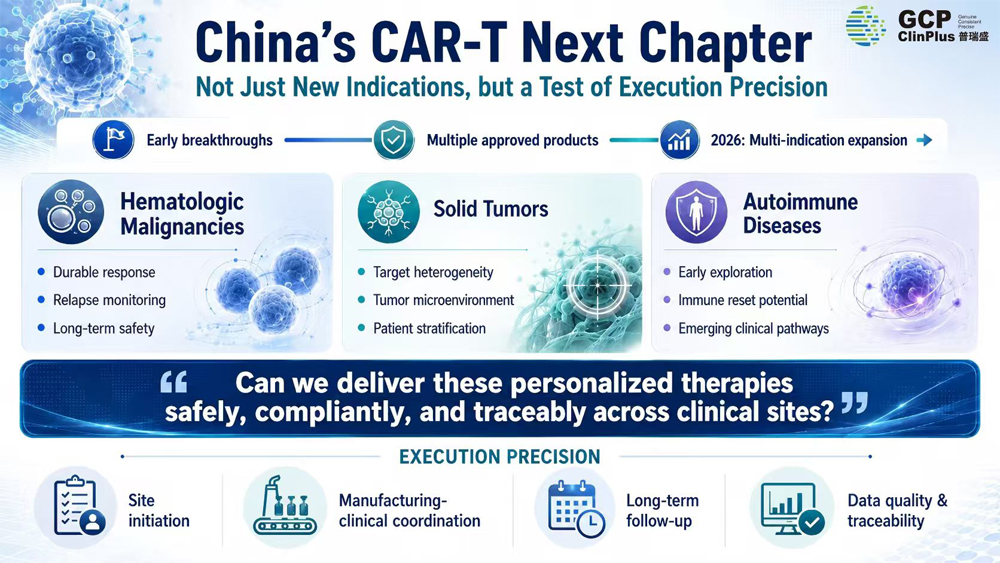
Over the past few years, we have witnessed the rapid maturation of China’s domestic CAR-T landscape — from early breakthroughs to multiple approved domestically developed products.
Now in 2026, the industry is quietly entering a new inflection point: multi-indication expansion.
In hematologic malignancies, the focus is shifting from whether patients respond to how durable responses can be, how relapse can be monitored, and how long-term safety can be managed.
In solid tumors, target heterogeneity, the tumor microenvironment, and patient stratification remain three key translational hurdles.
In autoimmune diseases and beyond, CAR-T is gaining traction as a potential immune-reset strategy, prompting more early-stage exploratory trials.
This complex landscape is redefining the core question for the next five years:
It is no longer just: “Does the therapy work?”
The real question is: “Can we deliver these personalized therapies safely, compliantly, and traceably across clinical sites?”
This raises the bar for site initiation, manufacturing-clinical coordination, long-term follow-up, and data quality and traceability.
At GCP ClinPlus, we are committed to addressing these execution challenges with integrated clinical research capabilities and AI-enabled workflows. As an AI-powered, full-service intelligent CRO, we are proud to have supported 2,300+ clinical studies globally, including 200+ international multi-center trials.
The next chapter of CGT is a dual challenge: expanding therapeutic frontiers while strengthening clinical evidence quality and operational rigor.
For those advancing CAR-T into solid tumors or autoimmune diseases, where do you see the biggest bottleneck today — site activation, patient selection, long-term follow-up, or data harmonization?
Let’s discuss below.
#CART #CGT #CellTherapy #ClinicalTrials #ClinicalOperations #Oncology #SolidTumors #AutoimmuneDisease #DataQuality #LongTermFollowUp #CRO #GCPClinPlus